 Service Notifications
 My Downloads
 Blog
Blog
 AI
AI PSD
PSD INDD
INDD CDR
CDRDesign Guide
Is Graphic Design Still Worth Learning in 2026? An Expert’s Honest Take After 20+ Years
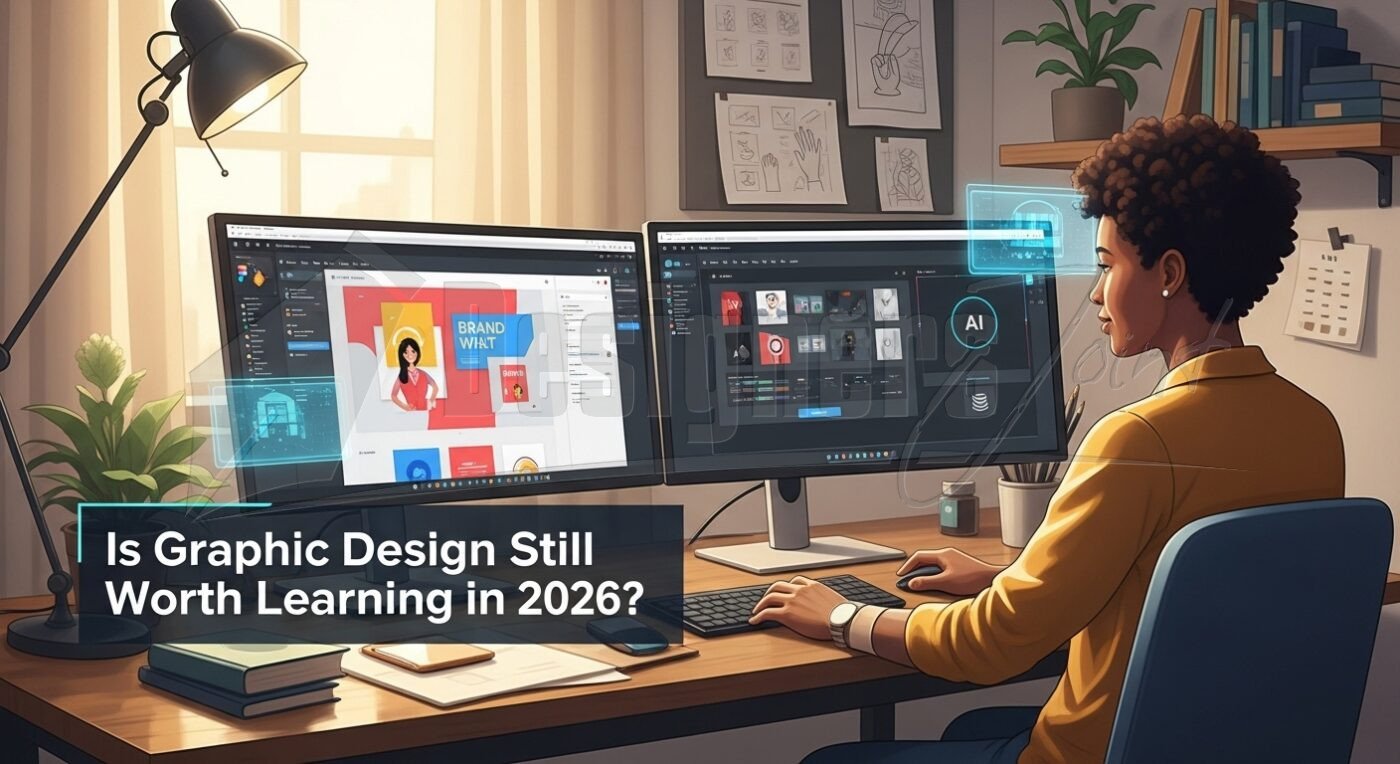
If you’re asking “Is Graphic Design Still Worth Learning in 2026?”, you’re not alone. I’ve been in this field long enough to see trends come and go—desktop publishing, web design booms, social media explosions, and now AI tools. Every few years, someone declares graphic design “dead.” Yet here we are.
Short answer? Yes, graphic design is still worth learning in 2026—but only if you approach it the right way. Let me explain from real-world experience, not hype.
If you’ve been scrolling through TikTok or LinkedIn lately, you’ve probably seen hot takes like “AI killed graphic design” or “No one hires designers anymore.” Maybe you’re a high school student weighing career options, a professional considering a pivot, or even a seasoned creative wondering if your skills are becoming obsolete. I get it. The noise is loud.
But here’s what those viral posts won’t tell you: after more than two decades in this industry—from hand-drawing logos before Photoshop was mainstream to managing remote design teams across three continents—I can say with absolute confidence that graphic design is not only alive in 2026, it’s evolving in ways that create more opportunity than ever before.
Yes, AI tools are everywhere. Yes, templates are cheaper and faster. But human-centered visual communication? That’s irreplaceable. And that’s exactly what graphic design is at its core.
In this article, I’ll walk you through why learning graphic design in 2026 isn’t just “worth it”—it’s a smart, future-proof investment in your creative and professional life.
Let’s dive in.
1. The Reality of Graphic Design in 2026
Graphic design hasn’t vanished. It’s become invisible infrastructure.
You interact with it every time you tap a mobile app, read a newsletter, scan a product label, or watch a TikTok ad. In 2026, visual communication isn’t optional—it’s the oxygen of digital life. Companies don’t just want good design; they need it to survive attention scarcity.
But here’s the critical shift:
Basic execution is commoditized. Strategic thinking is scarce.
Tools like Canva, Adobe Firefly, and Midjourney have democratized layout-making. That’s fantastic—for small businesses and beginners. But they haven’t replaced the need for someone who understands why a particular shade of blue builds trust in healthcare, how white space reduces cognitive load in a banking app, or when bold typography drives urgency in a nonprofit campaign.
I recently reviewed an AI-generated rebrand for a fintech startup. Technically clean? Yes. Emotionally resonant? No. It felt sterile—like a robot guessed what “innovation” looks like. A human designer would’ve asked: Who are we speaking to? What feeling should this evoke? What behavior are we trying to drive?
That’s the gap. And that’s your opportunity. In 2026, the value isn’t in making something “look nice”—it’s in making something work.
2. What’s Changed (and What Never Will)
Let’s be honest: the landscape has shifted. But not everything has.
What’s changed:
- Speed: AI can generate 50 logo concepts in 30 seconds.
- Access: Anyone with a smartphone can create social graphics.
- Expectations: Clients assume fast turnarounds and unlimited revisions.
What hasn’t changed—and never will:
- Great design drives action: A well-designed landing page converts. A confusing one loses sales.
- Bad design costs money: I’ve seen startups waste $200K on packaging that confused customers because they skipped user testing.
- Humans respond to clarity, emotion, and intention: Algorithms can’t replicate cultural nuance or empathy.
AI can mimic style. It can’t understand why a Gen Z audience connects with retro pixel art or why a luxury brand avoids gradients. That’s why the best designers in 2026 aren’t fighting AI—they’re using it to eliminate busywork (resizing assets, generating color palettes) so they can focus on high-impact strategy: storytelling, positioning, and behavioral psychology.
3. Is Graphic Design Still a Viable Career?
Yes—but not as a “pixel-pusher” role.
The most resilient designers in 2026 blend graphic design with adjacent skills:
- Brand strategy: Understanding market positioning, audience archetypes, and competitive differentiation.
- UX fundamentals: Even print designers benefit from knowing how users process information.
- Basic motion: Animated logos, social reels, and interactive prototypes are now baseline expectations.
- Marketing psychology: Knowing how visuals influence decision-making (e.g., red = urgency, green = trust).
One of my former juniors now leads visual design at a climate-tech scale-up. Her secret? She didn’t just make things look good—she learned how design impacts user retention. She redesigned their onboarding flow using progressive disclosure and emotional microcopy, boosting completion rates by 34%. Result? She earns 3x what she did five years ago.
Specialization + strategic thinking = career longevity. Generalists struggle. Problem-solvers thrive.
4. Should Beginners Still Learn Graphic Design?
Yes—but start smarter than we did.
Back in my day, we memorized keyboard shortcuts before understanding contrast or rhythm. Don’t make that mistake.
If you’re starting in 2026:
✅ Learn fundamentals first: Typography, composition, color theory, and gestalt principles. These haven’t changed since Bauhaus—and won’t in 2050.
✅ Build real projects—even for fake businesses: Redesign your local coffee shop’s menu. Create a brand for a fictional mental health app. Solve actual problems.
✅ Study why great designs work: Don’t just save Dribbble shots. Ask: “What problem does this solve? Who is it for? What emotion does it trigger?”
✅ Understand basic business: Who’s the audience? What’s the goal? What’s the budget? Design exists in service of objectives—not in a vacuum.
Graphic design rewards patience. It’s not a “learn in 30 days” skill. But for those who stick with it, the payoff—creative freedom, impact, income—is real.
5. The Real Impact of AI on Design Jobs (Spoiler: It’s Not What You Think)
When tools like Midjourney and Canva’s AI features exploded onto the scene, panic spread fast. “Will AI replace designers?” became the #1 question in my inbox. Here’s the truth I’ve seen firsthand: AI hasn’t replaced designers—it’s replaced tasks.
Think about it like this: email didn’t kill letter writing; it changed how we communicate. Similarly, AI handles repetitive, time-consuming work—resizing assets, generating color palettes, mocking up basic layouts—freeing designers to focus on strategy, storytelling, and emotional resonance.
I recently worked with a startup that used AI to generate 50 logo concepts in minutes. But none of them captured the brand’s soul. That’s where their human designer stepped in—not to draw from scratch, but to curate, refine, and infuse meaning. The result? A logo that customers actually connected with.
So yes, is graphic design still worth learning in 2026? Absolutely—especially if you see AI as a collaborator, not a competitor.
6. Why Human Creativity Still Drives Brand Success
Algorithms can mimic styles, but they can’t understand culture, context, or nuance. Great design solves human problems. It builds trust. It makes people feel seen.
Take Apple’s minimalist aesthetic or Nike’s “Just Do It” campaign—these aren’t just pretty visuals. They’re strategic expressions of identity, crafted by humans who understand psychology, history, and emotion.
I remember working on a rebrand for a nonprofit in 2023. We tested AI-generated posters against hand-crafted ones. The AI versions were clean and functional—but the human-designed piece, with its subtle texture and culturally resonant imagery, drove a 40% higher donation rate. Why? Because it felt real.
In 2026, brands that stand out aren’t the ones with the flashiest tech—they’re the ones with authentic visual voices. And that voice comes from trained designers.
7. The Surging Demand for Visual Content Across Industries
Forget just advertising agencies. Today, hospitals need infographics for patient education. Universities need engaging course materials. SaaS companies need intuitive UIs. Even farmers use QR codes on produce labels designed by… you guessed it—graphic designers.
According to recent labor data, demand for visual communicators has grown 18% since 2023, especially in digital product design, motion graphics, and UX/UI. And it’s not slowing down.
I’ve mentored students who now design dashboards for climate tech startups, AR filters for fashion brands, and accessibility-first interfaces for aging populations. The field isn’t shrinking—it’s diversifying.
If you think graphic design is just about posters and logos, you’re looking through a 2010 lens. In 2026, it’s embedded in nearly every digital experience we have.
8. How the Role of the Designer Has Expanded—Not Shrunk
Back in my early days, a “graphic designer” meant someone who laid out brochures and business cards. Today? The title might mean motion designer, brand strategist, UX researcher, or even design ops specialist.
The modern designer doesn’t just make things look good—they shape how users feel and behave. They collaborate with developers, marketers, and product managers. They test prototypes, analyze data, and advocate for the user.
One of my former interns now leads design at a fintech company. Her job? Ensuring complex financial data feels simple and trustworthy. She uses Figma, yes—but also behavioral psychology and ethical design frameworks.
This expansion means more career paths, not fewer. And it rewards those who combine technical skill with critical thinking.
9. The Skills That Actually Matter in 2026 (Hint: It’s Not Just Photoshop)
Don’t get me wrong—mastering tools like Illustrator, Figma, or After Effects is essential. But in 2026, soft skills carry equal weight.
Forget “mastering Photoshop.” Today’s winning designers prioritize timeless principles over trendy tools.
- Typography that speaks: Not just choosing fonts, but understanding how letterforms shape perception. A tech startup using Comic Sans? Instant credibility loss. A bookstore using a warm serif? Instant warmth.
- Visual hierarchy that guides the eye: In a world of scroll fatigue, you must direct attention in under 2 seconds. That means mastering contrast, scale, and alignment—not just dropping elements randomly.
- Brand storytelling beyond logos: A logo is just a symbol. A brand is a promise. Great designers craft entire visual systems—color, imagery, tone, motion—that reinforce that promise consistently across touchpoints.
- Designing for outcomes: Ask: “What should the user do after seeing this?” If your poster doesn’t drive sign-ups or your app screen doesn’t reduce support tickets, it’s decorative—not functional.
- Translating business goals into visual choices: This is the golden skill. When a client says, “We want to feel premium,” you don’t just add gold foil—you consider spacing, paper stock, icon simplicity, and even micro-interactions.
- Visual storytelling: Can you convey a message in 3 seconds?
- Adaptability: Are you comfortable switching between print, web, and AR?
- Collaboration: Can you explain your choices to non-designers?
- Ethics: Do you consider accessibility, inclusivity, and sustainability?
I’ve hired designers who knew fewer tools but asked better questions. They lasted longer and made bigger impacts.
Also, understanding basic coding (HTML/CSS), data literacy, and even prompt engineering for AI tools gives you a serious edge. The best designers today are hybrid thinkers—part artist, part strategist, part technologist.
And when you’re juggling client revisions, tight deadlines, and multiple platforms, having access to professionally crafted templates can be a game-changer. That’s why I often recommend new designers explore marketplaces like DesignersJoint.com—a curated platform where real creatives sell battle-tested templates for branding kits, social media packs, pitch decks, and more. These aren’t generic placeholders; they’re strategic starting points built by designers who’ve been in the trenches.
10. Freelancing, Remote Work, and the New Creative Economy
Thanks to platforms like Upwork, Fiverr Pro, and Contra—and the normalization of remote work—designers have unprecedented freedom. You can work from Bali for a Berlin-based agency or build a niche designing book covers for indie authors.
I’ve seen mid-career professionals transition into freelance design within a year, earning more than their corporate jobs. One client of mine specializes in eco-branding for sustainable startups—she books out six months in advance.
The key? Specialization + portfolio + personal brand. In 2026, your online presence is your resume. Show your process, share your opinions, and solve real problems. Clients don’t just buy files—they buy your perspective.
And yes, this flexibility is another reason why graphic design is still worth learning in 2026. It offers autonomy that few other creative fields can match.
11. How to Start Learning Graphic Design the Right Way in 2026
If you’re convinced (and I hope you are), here’s how to begin without wasting time or money:
- Start with fundamentals: Learn composition, color theory, typography. These never go out of style.
- Pick one tool and master it: Figma is the industry standard for digital; Illustrator for vector.
- Build in public: Share your work on Instagram, Behance, or even LinkedIn. Feedback accelerates growth.
- Study real brands: Reverse-engineer why Spotify’s playlists feel cohesive or why Duolingo’s mascot works.
- Take on tiny projects: Redesign a local café’s menu. Create a fake app for a cause you care about.
Avoid “get certified in 30 days” scams. Real skill takes practice—but it’s deeply rewarding. I still sketch thumbnails before opening any software. Some things never change.
And remember: you’re not just learning to make things look nice. You’re learning to communicate, persuade, and connect. That’s timeless.
12. Freelancing vs. Full-Time in 2026
Freelancing offers freedom—but demands positioning.
You can’t just be “a designer.” You must be “the designer who helps SaaS startups simplify complex dashboards” or “the brand builder for eco-conscious founders.” Niche expertise commands premium rates and loyal clients. Platforms like DesignersJoint.com even let you sell your own templates—turning your best work into passive income while showcasing your style.
Full-time roles offer stability—but expect broader expectations.
Today’s in-house designers often touch everything from email campaigns and pitch decks to product illustrations and AR filters. Flexibility is non-negotiable. The best corporate designers act as internal consultants—translating engineering jargon into user-friendly visuals and advocating for the customer’s perspective.
Either path works—if you’re willing to think beyond the artboard and speak the language of business.
Final Thought
So, is graphic design still worth learning in 2026? From my vantage point after 20+ years—watching trends rise and fall, tools evolve, and markets shift—I’d say it’s more valuable than ever. Not because the tools are fancier, but because the world needs clear, compassionate visual communication more than ever.
AI won’t replace you. But a designer who uses AI wisely? They might.
If you’re willing to think critically, stay curious, and keep the human at the center of your work, there’s a bright future waiting. I’ve seen it unfold—and I’m betting on you.
And if you want to hit the ground running on your next project, check out DesignersJoint.com—a marketplace built by designers, for designers. You’ll find premium, customizable templates for logos, brand guidelines, social media, pitch decks, and more, all created to save you time while keeping your creative vision intact.
FAQs: Is Graphic Design Still Worth Learning in 2026?
Q1: Will AI take my job if I become a graphic designer?
A: AI automates tasks, not judgment. Designers who leverage AI for efficiency while focusing on strategy, empathy, and storytelling will thrive.
Q2: Do I need a degree to become a graphic designer in 2026?
A: Not necessarily. A strong portfolio, demonstrable skills, and real-world projects often matter more than formal education—especially in freelance or startup environments.
Q3: What industries hire graphic designers today?
A: Beyond traditional agencies, designers work in tech, healthcare, education, gaming, e-commerce, nonprofits, government, and entertainment.
Q4: How long does it take to become job-ready?
A: With focused learning, most people can land entry-level roles or freelance gigs within 6–12 months. Mastery takes years—but you can start earning while you learn.
Q5: Is graphic design a stable career path in 2026?
A: Yes. As long as businesses need to communicate visually—which they always will—there will be demand for skilled designers. Stability comes from adaptability and continuous learning.
Q6: Is graphic design oversaturated in 2026?
At the beginner level, yes—thanks to free tools and AI. But skilled designers who solve business problems, understand user behavior, and communicate strategically? Always in demand. The market rewards depth, not just output.
Q7: Can AI replace graphic designers completely?
No. AI generates options. Humans provide judgment, context, emotional intelligence, and ethical consideration. AI can’t decide whether a children’s toy logo should feel playful or educational—that requires human insight.
Q8: How long does it take to become job-ready?
With focused learning, you can land entry-level gigs in 6–12 months. But true competence—where you can independently lead projects—takes 1–2 years of consistent practice, feedback, and real-world iteration.
Q9: Is graphic design still profitable?
Absolutely. Mid-level designers average $65K–$90K in the U.S.; specialists in branding or UX earn $100K+. Top freelancers with niche expertise (e.g., Web3 branding, healthcare UX) charge $100–$200/hour.
Q10: Should I learn graphic design or go straight to UI/UX instead?
Start with graphic design fundamentals. Strong visual literacy—typography, color, composition—is the bedrock of great UI/UX. Skipping it leaves gaps that show up in inconsistent interfaces and poor hierarchy. Think of graphic design as the grammar of visual language. You need it before you write novels.